
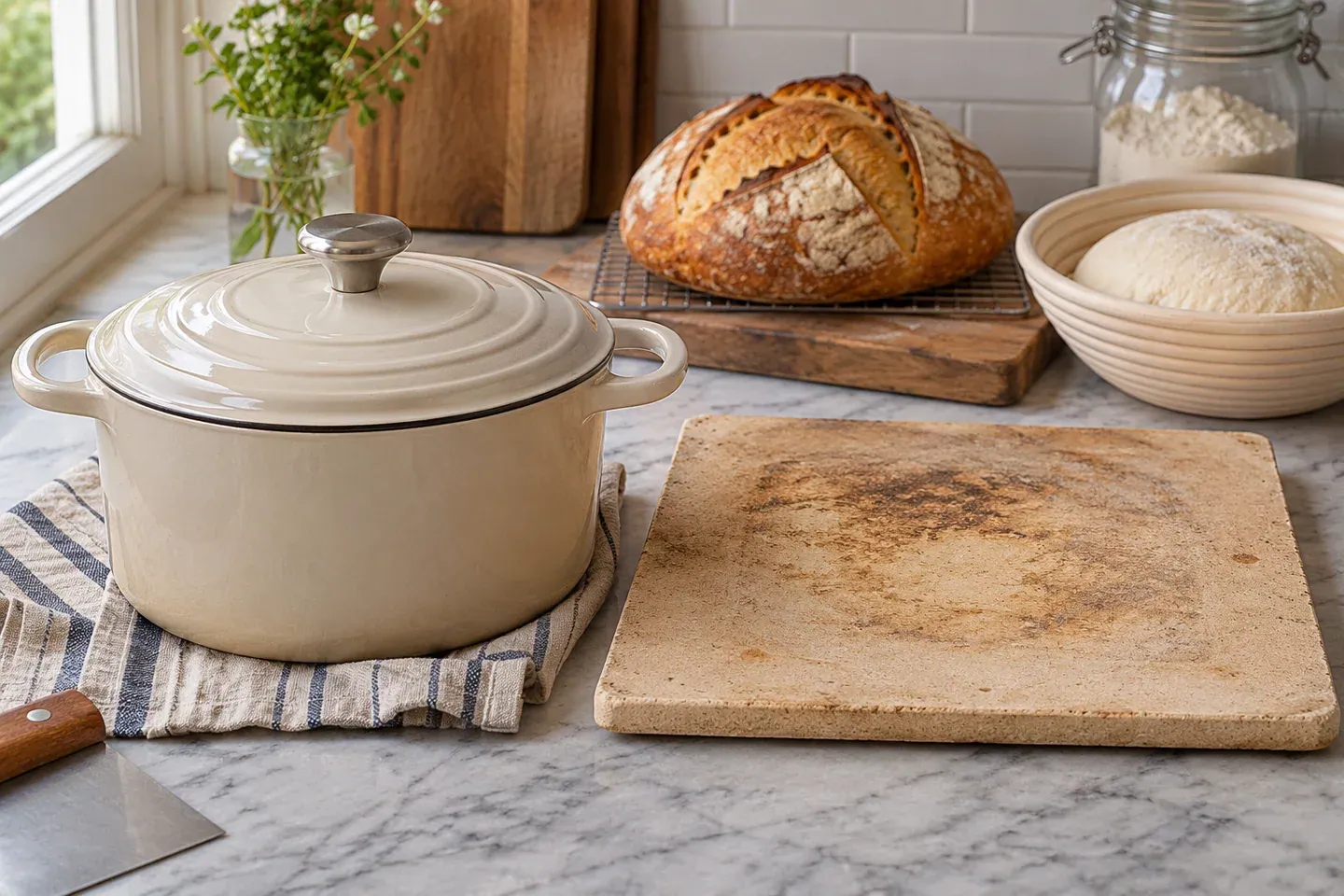
A Dutch oven gives a loaf an enclosed baking environment, while a baking stone provides a heated surface in the more open oven. For one small crusty loaf, a suitable covered vessel can simplify moisture management. For long loaves, several breads, or shapes that do not fit a pot, a stone offers more layout flexibility but requires a compatible recipe and loading method.
Neither tool automatically produces good bread. Dough development, fermentation, shaping, and the complete bake still matter. Choose the setup that fits your loaf, cookware instructions, oven, and handling comfort rather than buying equipment to repair a problem that began in the mixing bowl.
What each tool contributes
A covered Dutch oven surrounds the dough with a hot vessel and retains some moisture released by the loaf. Many methods begin covered and finish uncovered so that expansion and later crust development happen under different conditions. The details depend on the particular recipe and pot.
A baking stone stores heat and transfers it to the dough at its surface. The top of the loaf remains exposed to the oven environment. Recipes may provide a separate steam strategy or use another approach to manage the early bake. The stone alone is not a lid or a complete steam system.
The distinction is more useful than saying that one produces steam and the other produces heat. Both operate within a heated oven, and both involve heat transfer. What differs is the physical arrangement around the loaf and how the whole method manages expansion and moisture.
Compare the setups directly
| Consideration | Dutch oven | Baking stone |
|---|---|---|
| Loaf shape | Limited by the vessel's usable shape and lid clearance | More flexible, within the stone and oven dimensions |
| Early moisture environment | Covered methods retain some loaf moisture | Depends on the recipe and any compatible steam method |
| Loading | May involve transferring dough into a vessel | Usually needs a suitable peel, sling, or transfer technique |
| Capacity | Often one loaf per vessel | May allow several small breads or a long loaf |
| Preparation | Must follow vessel-specific heat and preheating instructions | Must follow stone-specific placement and heating instructions |
| Handling | A pot and lid can be heavy and very hot | Loading and unloading an open hot surface require control |
Use the table to identify the practical constraint that matters most. If a loaf cannot fit below a pot's lid, the vessel is not suitable merely because its material has a good reputation. If you cannot load a sticky dough cleanly onto a stone, surface area alone is not an advantage.
A covered pot can simplify one-loaf baking
For a modest round or oval loaf, an approved covered-vessel method can reduce the need to design a separate steam setup. That can be useful for a home baker who wants to focus on one dough and one repeatable loading sequence.
The lid and interior space still need attention. The expanding loaf should have appropriate clearance, and every component must be suitable for the intended temperature. Knobs, handles, coatings, and the pot body can carry different restrictions, so read the instructions for the entire product.
Do not assume empty preheating is approved for every Dutch oven. Le Creuset's bread guidance explicitly says it does not recommend heating an empty Dutch oven and describes another approach. Other cookware and recipes may have different instructions; follow a compatible combination rather than borrowing only the hottest step from a demonstration.
Our no-knead draft uses a preheated vessel only where the manufacturer permits that use. If your vessel does not allow it, choose a method designed around its restrictions instead of improvising a cold start while retaining every original time unchanged.
A stone offers space and shape flexibility
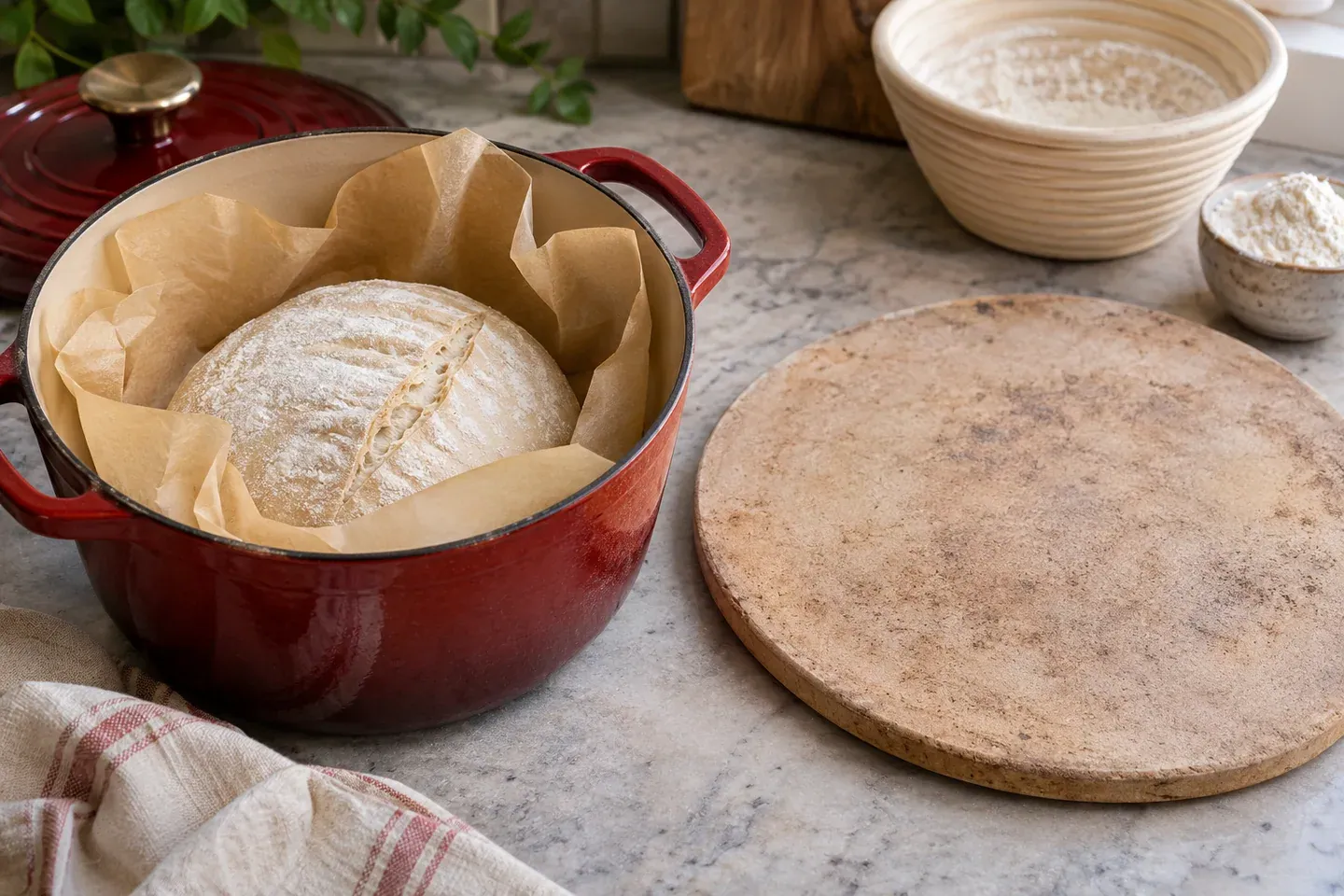
A stone can suit long breads or multiple smaller loaves that cannot share a pot. Its practical capacity depends on the actual usable surface and oven clearance, not only the advertised outside dimension. Leave the circulation and handling space required by the appliance and method.
Preheating a substantial surface requires its own instructions. The oven's ready signal does not necessarily mean every part of a heavy stone has reached the condition intended by the recipe. Prepare it in the correct position from the beginning rather than trying to move it while very hot.
Loading is a skill worth considering before buying. A dough can stick to a peel or transfer surface if it waits too long or is poorly prepared. Practice the sequence with an appropriate method so that you are not reaching toward a hot stone to pull a stuck loaf free by hand.
If the recipe uses parchment, check the material's temperature rating and keep it away from heating elements. A transfer aid should solve a handling problem without introducing a material that is unsuitable for the intended bake.
Decide how moisture will be managed
The covered-vessel approach and an open stone method may use different early environments. Follow the recipe's sequence, including when a lid is removed or when a particular steam stage ends. These are parts of a system, not decorative extras.
Do not improvise by pouring water onto hot glass, onto a stone, or around exposed heating elements. Use only a steam method that is compatible with the oven and equipment. A recipe on another appliance may not account for the surfaces and components inside yours.
A covered pot also needs safe opening. Steam can escape when the lid is removed, so position your hands and face accordingly and have a stable heat-resistant place for the lid. Loading and uncovering should be planned before the dough is ready.
If you do not want to manage an additional steam process, choose a method and bread style that fit that preference. Not every useful home loaf requires the same crust as a bakery-style artisan bread. A pan loaf or another straightforward method may meet your needs better than a more elaborate setup.
Consider the bread you actually bake
If you regularly make one small sourdough round, a suitably approved pot may be convenient. Confirm the dough weight, proofed dimensions, and lid clearance. A very large pot is not automatically necessary for a modest loaf and may create a handling burden without solving a baking problem.
If you want baguette-like shapes, several flatbreads, or different layouts, a stone's open surface may fit those projects better. Each bread still needs its own formula and baking instructions. The same surface does not turn every dough into a long-loaf recipe.
If your main bread is a soft sandwich loaf, neither purchase may be essential. A suitable loaf pan and consistent oven method can be a more direct investment. The pan selection guide focuses on that type of baking rather than treating every bread as a freestanding artisan loaf.
Use existing equipment when it genuinely fits the method. A purchase should solve an identified limitation, such as insufficient shape clearance or an unsuitable loading surface. It should not be based on an unsupported promise that a particular material fixes weak fermentation.
Evaluate handling as carefully as crust
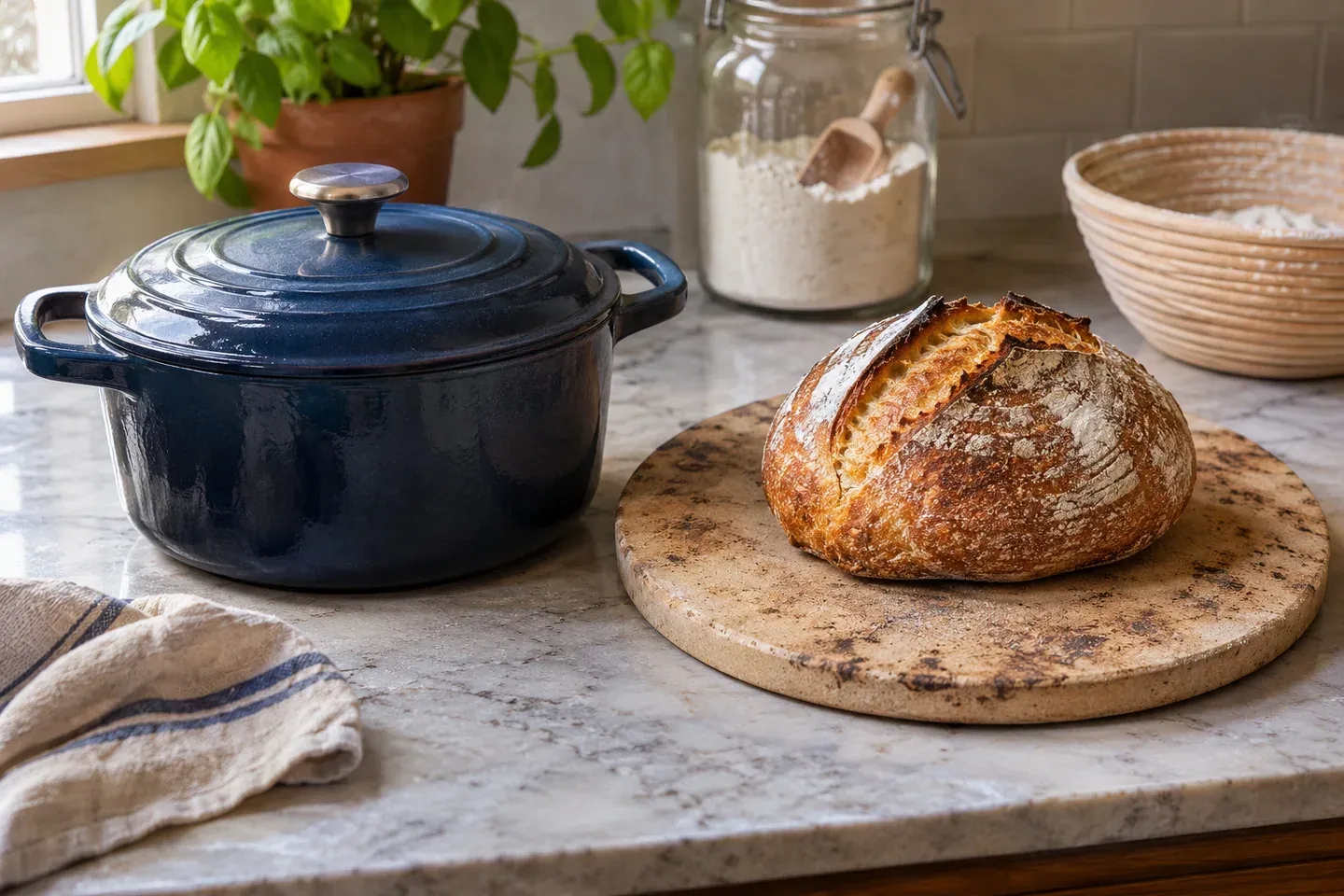
A heavy vessel becomes heavier with dough inside and more difficult to control when hot. Check whether you can lift and position it securely with suitable oven mitts and a rack height that works for you. That practical fit matters more than a dramatic product photograph.
A stone may remain in the oven during baking, but dough and finished bread still have to move safely. Consider the peel length, doorway clearance, and landing area. A large surface that is awkward to reach can be less useful than a smaller setup you handle confidently.
Plan cooling space for bread and equipment. Do not assume that a hot lid, pot, peel, or baking surface can be placed on any nearby counter. Follow the materials' handling instructions and keep the working area organized before you begin.
Compare results without inventing a test
If you try both setups, record the recipe, loaf size, proofing, oven mode, and full heating method. Differences in the finished loaf may reflect several changes, not the tool alone. A cold-start pot method and a hot-stone method are not an isolated laboratory comparison of material.
Look at the cooled crumb, crust, base color, and ease of use. A darker base is not automatically proof of superior performance, and a dramatic ear does not establish that the entire loaf is better. Judge the bread you want to eat and the routine you can repeat.
This publication does not claim product testing or rank individual models here. For a specific purchase, inspect current manufacturer instructions and dimensions. Those details can change across product lines even when a familiar brand name remains the same.
Care and storage
Follow the particular vessel or stone's cleaning instructions. Rules about soaking, detergents, dishwasher use, abrasives, seasoning, and drying are not universal across all materials. Do not apply cast-iron care automatically to enamel, glass, ceramic, or a manufactured stone.
Inspect the equipment's condition before repeating a high-heat bake. If a component is damaged, follow the manufacturer's guidance rather than inventing a repair based on another material. Store the equipment where it can remain stable and where its weight does not make ordinary kitchen access awkward.
Which should you choose first?
Choose an approved covered vessel for a compatible single-loaf method if moisture management and repeatability are your main priorities. Choose a stone when loaf shape, layout, and an open baking surface are the clearer needs and you are ready to learn its loading method.
If neither solves a real limitation in your current baking, keep working with an appropriate existing setup. Improving flour measurement or proofing observations can make a larger difference than adding equipment whose purpose is still unclear. The right tool supports a method; it does not replace one.