
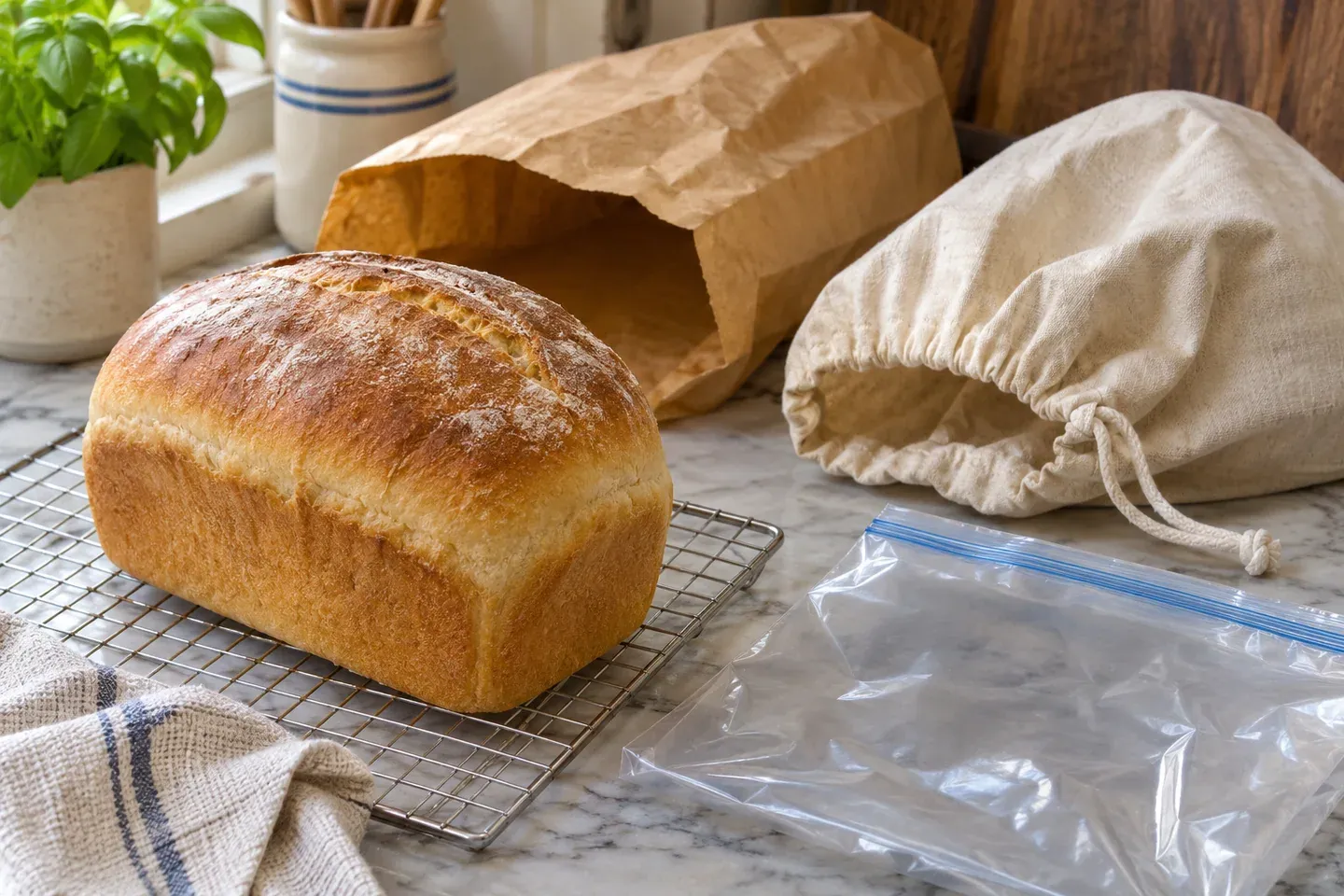
To store homemade bread well, cool it completely, protect the portion you will eat soon, and freeze what you will not use promptly. The right wrapping depends on whether you want to preserve a crisp crust or a soft sandwich-style surface. No wrapping method can guarantee a fixed safe number of days in every kitchen.
This guide focuses on ordinary, fully baked bread without perishable fillings or toppings. Bread containing ingredients that require refrigeration needs its own storage instructions. Texture preferences should never override the handling requirements of a cream, meat, cheese, or other perishable addition.
Separate freshness, staling, and spoilage
Bread can become firmer or less pleasant without displaying the same changes as spoiled food. Moisture loss and changes within the crumb affect eating quality, while visible mold is a different issue. Calling both conditions stale can lead to poor decisions about whether a loaf should be reheated or discarded.
A dry but otherwise suitable slice may have a useful role as toast. A moldy slice does not become suitable because it is toasted. Make the safety decision before deciding how to improve texture, not afterward.
Appearance and smell are useful observations, but they do not turn an uncertain storage history into a guarantee. Know what went into the bread and how it was handled. A plain wheat loaf and a loaf with a perishable filling should not share an automatic countertop rule.
Cool before choosing the package
Freshly baked bread releases moisture as it cools. A tight bag around a warm loaf traps that moisture and can leave the surface damp. A cooling rack lets air reach the underside rather than holding steam against a plate or the baking pan.
Wait until the loaf is fully cool before sealing it for storage. A small roll and a large dense loaf cool at different rates, so one universal timer is not enough. If the center still feels warm, the loaf is not ready for a tightly closed package simply because the crust feels less hot.
Avoid leaving bread exposed far longer than needed after cooling. In a dry room, the cut surface can lose moisture while you are waiting for a storage decision. Have the bag, wrapping, or freezer portions ready as part of the baking routine.
If you are storing purchased bread, follow its label when it supplies specific instructions. Packaging and ingredients can differ from a homemade loaf, so an observed shelf life for one commercial product should not become a promise for your own bread.
Choose according to the crust you want
For a soft sandwich loaf, food-safe wrapping that limits moisture loss helps maintain a softer surface. Close the package appropriately once the bread is cool. Leaving a thin-crusted loaf exposed for a long period generally works against that soft texture.
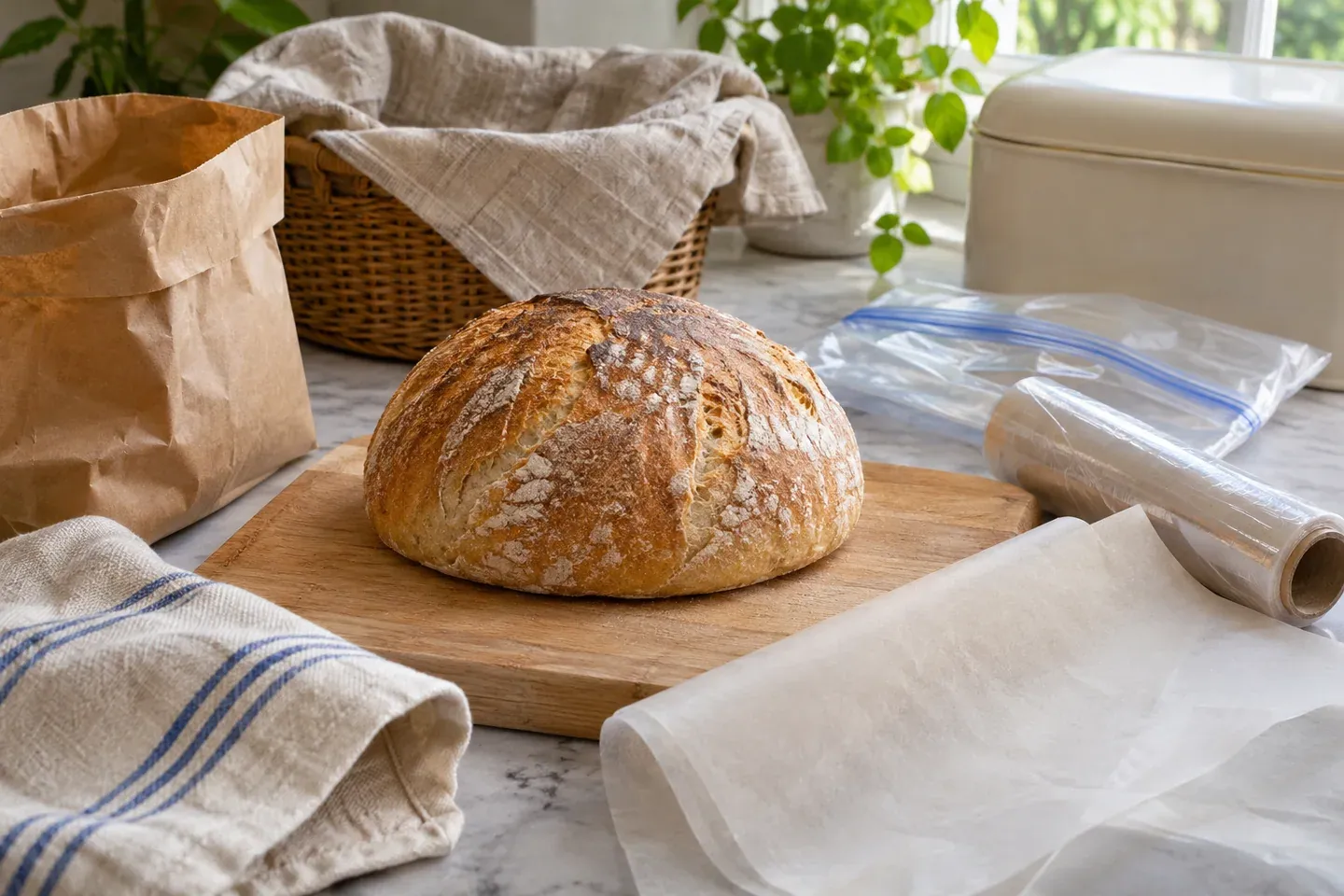
For a crusty artisan loaf, a more breathable arrangement can help preserve a drier exterior temporarily, but the crumb will also lose moisture. Paper or a clean cloth is therefore a short-term texture choice, not a method that makes a loaf remain fresh indefinitely.
Once a loaf is cut, the exposed crumb deserves attention. For an immediate serving period, resting the cut face against a clean board can reduce exposure at that surface. Add suitable protection for the rest of the loaf and choose longer storage deliberately rather than leaving it in the same position for days.
Expect a trade-off. A bag that keeps the crumb softer can soften a crisp crust, while a breathable wrap can protect crust texture at the cost of faster drying. Choose the compromise that fits the next meal, then use the freezer when a longer delay is expected.
Use room-temperature storage deliberately
Choose a clean, suitable place away from direct sunlight, excessive heat, and contamination. A location that becomes warm during cooking may behave differently from a cooler cupboard. Humidity also matters, so another household's reported storage time may not match yours.
For quality planning, think about the bread you will eat within the next day or couple of days and freeze the remainder early. King Arthur Baking's storage guide recommends freezing portions for longer storage rather than relying on an extended room-temperature hold.
That is not a food-safety expiration date. A loaf can develop problems sooner under unsuitable conditions, while different formulas behave differently. Check the food and its handling rather than treating a calendar estimate as permission to ignore spoilage.
If you use a bread box, keep it clean and follow its intended use. A box is a storage environment, not a device that cancels moisture or prevents all mold. Remove crumbs and old bread before adding a new loaf so that the next bake does not begin beside neglected residue.
Understand the refrigerator trade-off
Refrigeration can make ordinary bread become stale in texture more quickly than a suitable room-temperature or frozen storage plan. That is why the freezer is often a more useful long-term quality choice for plain bread. A cold loaf is not automatically better preserved in the way you want to eat it.
This does not mean that refrigeration is inherently forbidden or unsafe for bread. If a filling or topping requires it, follow that requirement. In difficult household conditions, you may also need to choose between competing practical considerations rather than applying a rigid texture rule.
When refrigeration is necessary, package appropriately to limit drying and use portions sensibly. Do not expect a brief warming to restore every characteristic of a freshly baked loaf. It can improve eating quality without undoing all changes from storage.
Avoid moving the whole loaf repeatedly between cold storage and a warm counter simply to take one slice. Portioning makes it easier to retrieve what you need while leaving the remainder protected. The same principle is useful when freezing bread.
Freeze early for a longer useful life
Freeze bread while it is still in good condition rather than waiting until it is already disappointingly dry. Let it cool, divide it according to how you serve it, and package to limit moisture loss. A full loaf is convenient only if you normally need a full loaf at once.
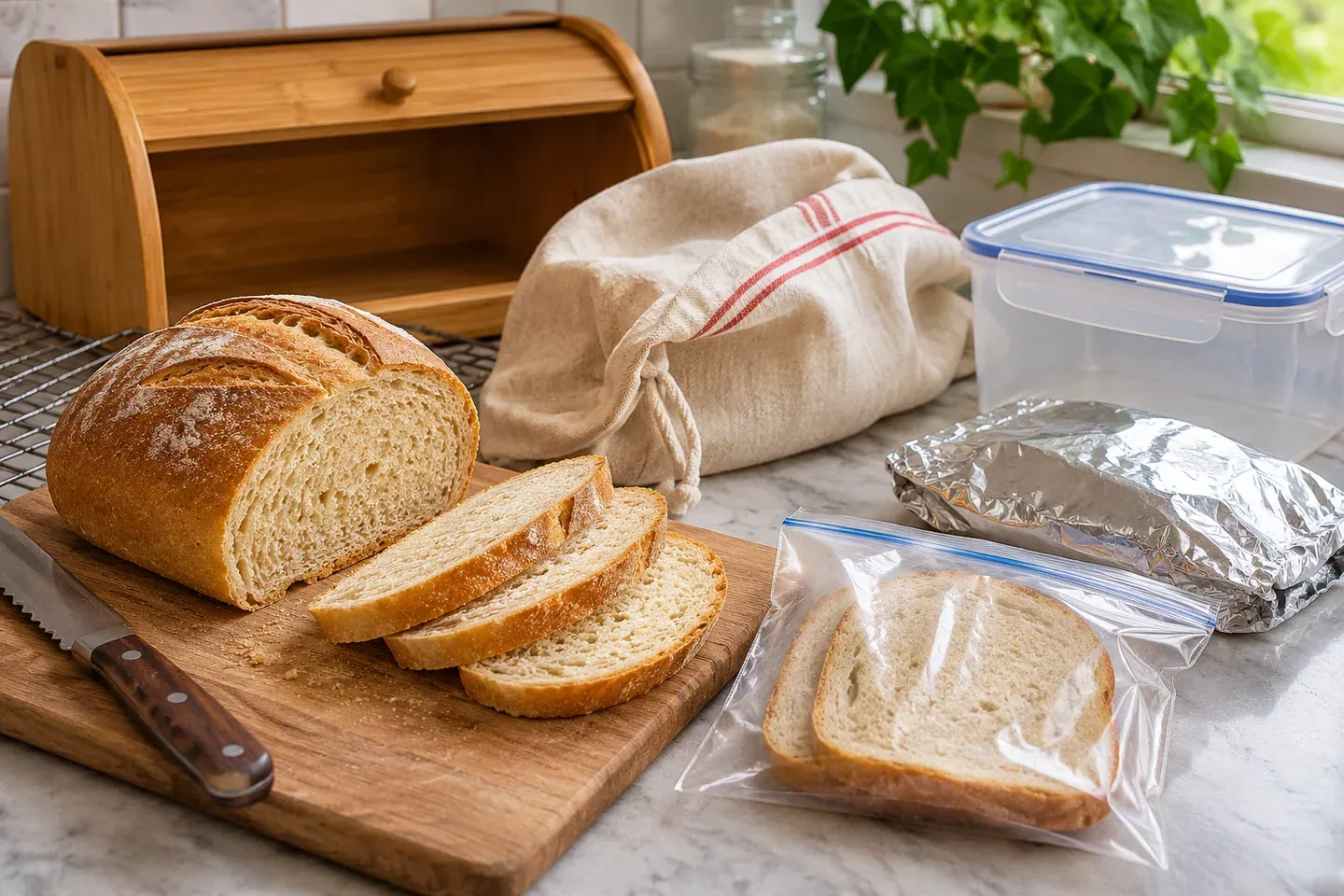
For everyday toast, slices or small groups of slices can be more practical. Separate them appropriately so that they are not frozen into a single block you must thaw repeatedly. Whole or half loaves can suit a shared meal when you want to refresh a larger portion together.
Label the package with the bread type and date. Those details prevent a forgotten freezer loaf from becoming an unidentified item. The freezing and reheating guide covers the actual packaging and warming sequence in more detail.
Freezing is not a rescue for spoiled bread. It does not make a moldy loaf suitable to eat or erase unsafe handling that happened before freezing. Decide whether the bread is appropriate to store before you select the method.
Match the method to the next use
| Your main need | Useful approach | Trade-off to expect |
|---|---|---|
| Soft slices for near-term sandwiches | Cool fully and use suitable closed food-safe wrapping | Crust stays softer rather than crisp |
| A crusty loaf for an immediate meal | Limit unnecessary wrapping during the short serving period | Exposed crumb can dry if left too long |
| Portions for later in the week | Freeze useful serving sizes while the bread is still good | Requires appropriate thawing or direct reheating |
| Bread with a perishable addition | Follow that recipe or label's storage requirements | Food handling takes priority over crust preferences |
The table organizes a decision rather than assigning guaranteed lifetimes. Use it alongside the actual formula and household conditions. A method that works for a plain sourdough round should not be copied uncritically for a filled enriched loaf.
Recognize when to discard
If bread develops visible mold, discard the affected bread rather than cutting around the spot. USDA's mold guidance identifies bread as a porous food in which contamination can extend beyond what is visible.
Do not use smelling the mold closely as a test. Nor should you plan to remove the visible patch and toast the rest as a safety measure. A texture-refreshing method is not a treatment that makes spoiled bread acceptable.
Clean the storage area and examine other food kept nearby as appropriate. Adding a fresh loaf to an unclean bread box or bag does not solve the situation. Keep food-safe storage materials clean, dry, and suitable for reuse according to their instructions.
Build storage into the baking routine
Suppose you bake a loaf larger than your household will use in the next couple of days. Rather than leaving it whole until it becomes firm, cool it and freeze a portion immediately. Keep the smaller near-term portion protected in the way that suits its crust.
This is a planning example, not a prediction of exactly how long every loaf remains suitable. Its value is that it moves the decision earlier, while quality is still good. It also reduces repeated warming and unnecessary waste.
Record the method that worked for a bread you repeat. You may prefer a different arrangement for the white pan loaf than for the crusty no-knead loaf. Matching storage to the bread's purpose is more useful than searching for one container that solves every loaf.
Storage questions
Should I slice the whole loaf immediately?
Slice according to how you will use or freeze it. Leaving the near-term portion intact can reduce exposed crumb, while pre-slicing the freezer portion makes individual servings easier. There is no need to choose the same treatment for both parts.
Can reheating restore any old bread?
No. Reheating can improve the eating quality of suitable bread, but it does not reverse spoilage or every change from storage. Make the safety decision first, then use an appropriate warming method for the bread you intend to eat.
What matters most?
Cool fully, choose protection for the crust and crumb you want, and freeze the surplus early. Observe the actual bread and its conditions rather than relying on a fixed day count or a container's marketing promise.