
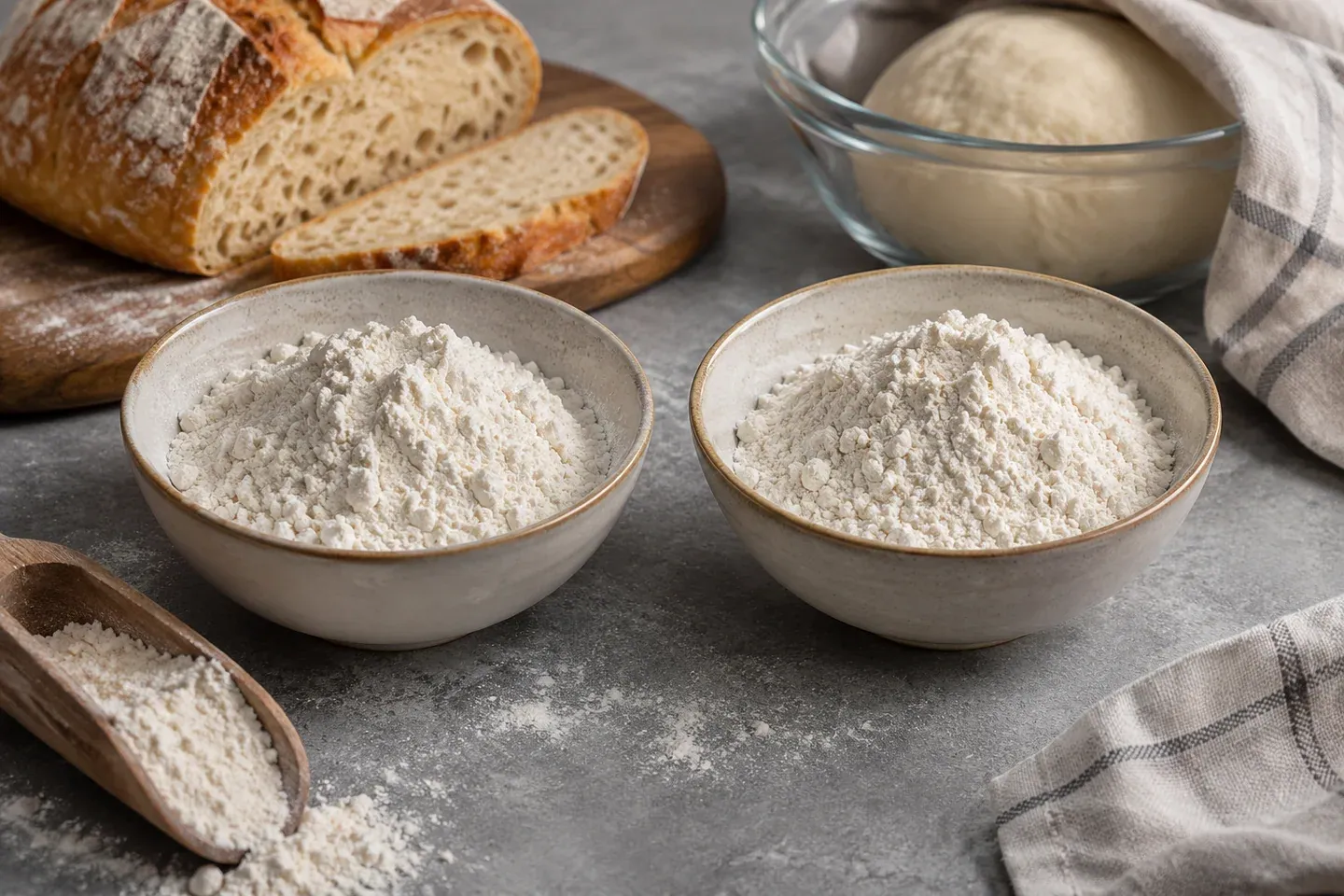
Bread flour vs all-purpose flour is mainly a question of the dough strength a recipe expects, not whether one bag is universally better. Bread flour commonly has a higher protein content and can support a stronger, chewier wheat dough. All-purpose flour can also make excellent bread when the formula is designed around its characteristics.
Start with the flour named in your recipe. If you need to substitute, weigh consistently and observe the dough before making additional changes. A flour swap can alter absorption and handling even when the ingredient quantity stays the same, so it is more useful to understand the difference than to apply a universal correction.
What the labels actually tell you
Bread flour is milled and marketed for applications that benefit from stronger wheat dough. All-purpose flour is intended to work across a broader range of household baking. Those names describe a general purpose, but they do not guarantee an identical specification across every brand and country.
Read the package and manufacturer's information where available. A bag labeled all-purpose in one market may not behave exactly like another product with the same English name elsewhere. Protein content, wheat selection, and milling all contribute to what reaches your mixing bowl.
As one clearly identified brand example, King Arthur Baking reports 12.7% protein for its bread flour and 11.7% for its all-purpose flour. Those figures describe those products, not a global definition of every bread or all-purpose flour sold.
Do not infer that a one-percentage-point difference will translate into a fixed increase in loaf height. Bread making is a system. A more protein-rich flour still needs appropriate hydration, development, fermentation, shaping, and baking to produce the intended result.
Compare the practical differences
| Question | Bread flour | All-purpose flour |
|---|---|---|
| Typical purpose | Wheat doughs needing stronger structure | A broad range of everyday baking, including suitable bread recipes |
| Protein tendency | Often higher, depending on product | Often moderate, depending on product |
| Dough feel | Can feel stronger or more elastic in a suitable formula | Can feel softer in the same formula |
| Water behavior | May accommodate more water, depending on the flour | May need closer observation in a formula developed for stronger flour |
| Useful goal | Chewier breads or formulas built for strength | Tender everyday breads and versatile household baking |
These are tendencies rather than promises. The same recipe may show a noticeable difference with one pair of flours and a smaller difference with another. The table should guide observation, not replace the recipe's instructions or the actual product specification.
Understand protein without reducing bread to a number
Water and mixing help wheat proteins form the network bakers call gluten. That network contributes to the dough's ability to stretch and retain fermentation gas. A flour with greater potential strength can be useful in a recipe that asks the dough to hold its shape or support substantial expansion.
Strength is not the same as hardness. A dry dough made from extra flour can feel firm while still handling poorly. Conversely, a well-developed dough can be soft and extensible. Do not use resistance under your hands as the only measure of whether a flour is working.
The rest of the formula also matters. Whole grains, seeds, fat, sugar, and other ingredients change the dough's behavior. A flour chosen for one enriched loaf may not provide the same experience in a wet, lean artisan recipe. Compare like with like before deciding that a product is inherently unsuitable.
For a new flour, a simple recipe is a useful test. You can observe mixing, development, and rise without many inclusions obscuring the comparison. Keep notes rather than relying on a memory that one dough felt vaguely better than another.
Choose according to the bread you want
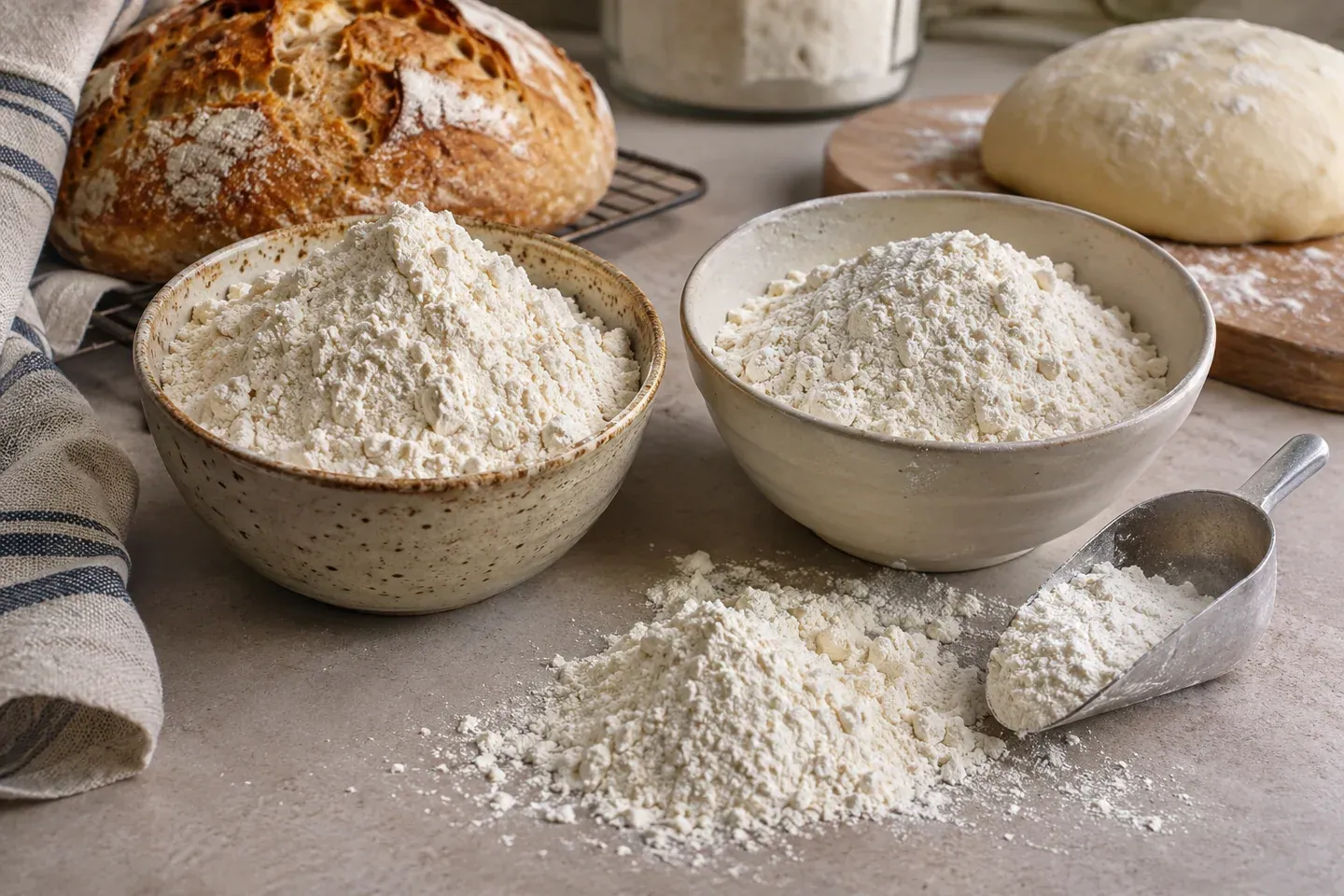
For a chewy loaf or a recipe explicitly developed with bread flour, begin with bread flour if available. That keeps the formula's intended balance intact while you learn its normal behavior. A flour substitution is easier to assess after you have seen the original dough at least once.
For soft everyday rolls or a tender pan loaf, a suitable all-purpose flour can work well when the recipe names it. More protein is not automatically an improvement if the desired texture is less chewy. Follow the bread's purpose rather than treating the strongest available flour as a universal upgrade.
For a high-hydration artisan loaf, the chosen flour and handling method are especially closely connected. A softer flour may spread more in the same wet formula. That does not mean that all-purpose flour cannot make artisan bread; it means that a recipe designed for it is a more reliable starting point.
For a first pan loaf, our white bread draft keeps the structure and measurements straightforward. Use one flour consistently during early attempts so that the learning focuses on handling and fermentation rather than several changes at once.
Substitute by weight, then assess
When a substitution is reasonable for the selected recipe, replacing the flour by weight gives a clearer comparison than changing cup amounts. Two bags can pack differently into a cup. A substitution that changes both flour type and the actual flour quantity creates two variables instead of one.
Keep the recipe's liquid quantity available and observe the mixture after a short hydration rest. If your chosen method permits reserving a small amount initially, record that choice and add it gradually as needed. Do not impose a fixed water reduction on every all-purpose substitution.
For example, with 400 grams flour and 260 grams water, holding back 10 grams during initial mixing can be an observation exercise in a flexible draft method. It is not a scientifically determined conversion factor. You may still need all the water, and a recipe developed for a specific consistency should remain your reference.
Avoid correcting a freshly mixed dough too quickly. Flour needs time to absorb liquid, and dough development changes handling as you work. The measuring guide and kneading guide help separate a flour difference from measuring or handling errors.
Do not confuse a flour swap with a new grain formula
Replacing refined wheat bread flour with refined wheat all-purpose flour is not the same as replacing it with whole wheat, rye, rice flour, or a gluten-free blend. Those changes can require a much more substantial redesign of the recipe.
Whole wheat includes bran and germ and changes absorption and structure. A full substitution can produce a different loaf even when its protein percentage looks similar. Use the whole wheat recipe draft for a method designed around that flour rather than assuming a number on a label settles the issue.
Gluten-free blends do not reproduce wheat dough simply because they are labeled for baking. They may need different liquids, binders, mixing, and pans. Choose a purpose-designed recipe rather than applying wheat kneading and proofing tests to a fundamentally different mixture.
Adding vital wheat gluten is also a separate formulation choice. It can change dough characteristics, but an unmeasured spoonful does not make one flour identical to another manufacturer's bread flour. Follow a suitable formula or product guidance if you choose that approach.
Read the result before blaming the flour
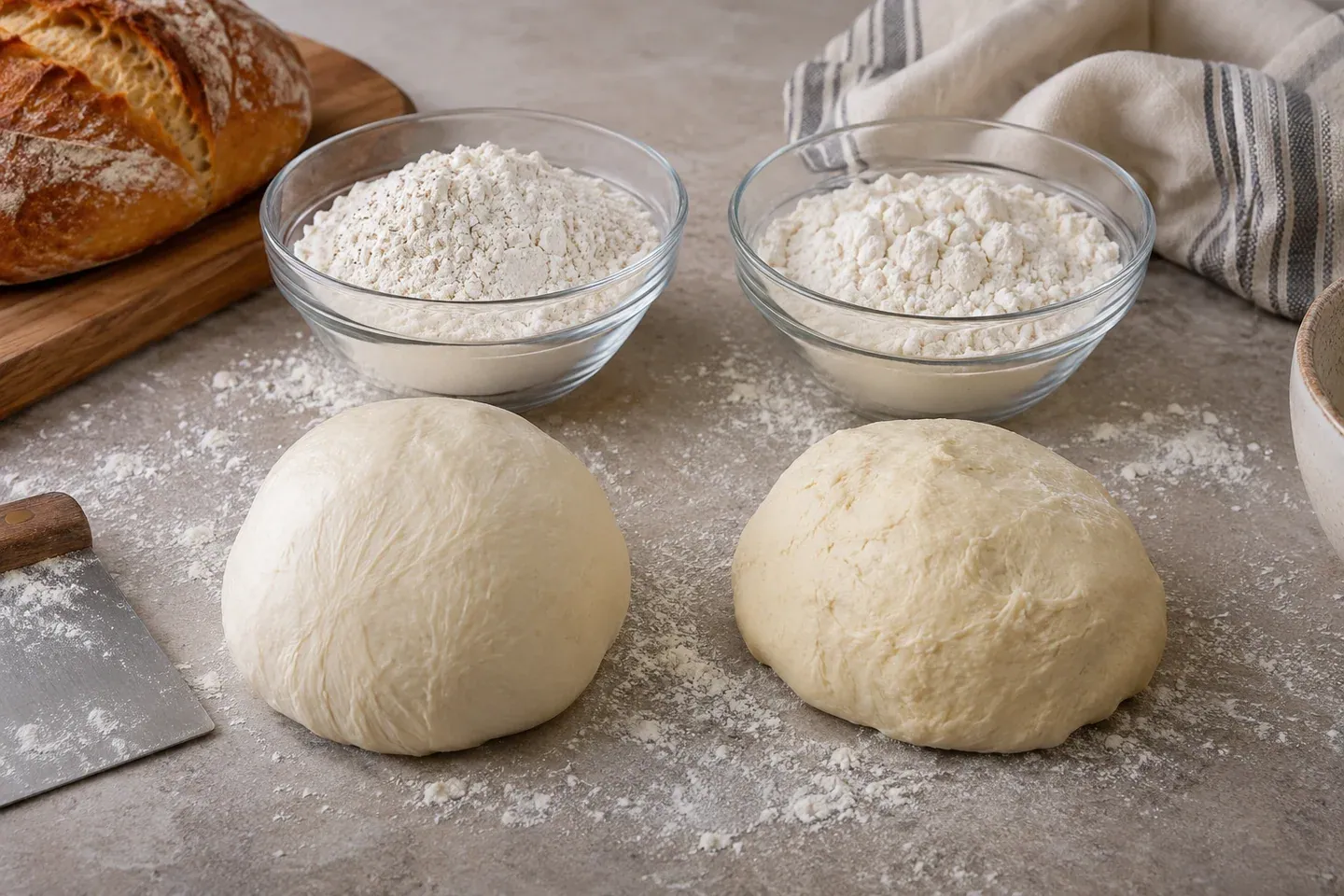
A flat loaf can reflect insufficient development, fermentation problems, or shaping as well as flour choice. A tight loaf may contain excess flour from measuring or counter dusting. Those possibilities should be reviewed before changing brands or adding more protein.
Compare cooled slices and dough-stage observations from the same recipe. Did one dough absorb water differently? Did it become smoother during kneading? Was it shaped and proofed to a comparable stage? Without those details, a finished photograph cannot isolate flour as the cause.
Use one deliberate change on the next attempt. Keep the formula, pan, and method steady while comparing the flour. If you also change hydration, yeast, shaping, and baking temperature, the result may be useful bread but it is not a clear flour comparison.
Store either flour with care
Keep flour protected from moisture, pests, and strong odors, following the package's storage directions. Label containers so that different flour types are not confused. A clean scoop and a consistent measuring routine help prevent an accidental substitution from looking like a mysterious recipe failure.
Treat both flours as raw ingredients. Do not taste uncooked dough or assume a flour marketed for bread is ready to eat. Follow FDA flour-handling guidance for preparation and cleanup.
Flour comparison questions
Can all-purpose flour make good bread?
Yes, when the product and recipe are suitable. The useful question is whether the formula expects its strength and absorption, not whether the name includes the word bread. Choose a recipe designed for the flour you have when possible.
Will bread flour always make a loaf taller?
No. Potential strength is only part of the system. Inadequate water, development, fermentation, or baking can still produce a disappointing loaf. A stronger flour should not be used as a substitute for diagnosing the process.
Which flour should I buy first?
Buy the flour named in the recipe you actually plan to repeat. If your household needs one versatile flour, a suitable all-purpose product can support many recipes. If your main goal is a specific bread-flour loaf, use the intended product before experimenting with substitutions.